Competence Centre for Global Innovation

What We Do

At the Competence Centre for Global Innovation (CC-GI), we invent, improve and develop models and tools that companies use to compete globally with new products, know-how and technologies. We use research and frameworks from different disciplines such as innovation, R&D, strategy, international business, and organization science to understand better how firms, teams, and individuals effectively innovate across geographics distances. Some example questions of our cross-border innovation research include:

  • How do we identify and transfer local innovations to become global innovations?
  • How do we build sustainable organizational competence into global R&D centres?
  • What can countries do to retain technological sovereignty against innovators from emerging markets?
  • How to align global business strategies with local subsidiary development?

Why This Matters

As companies grow and expand into new markets, they develop specific solutions and organizations targeting local opportunities. This leads to a dispersion of R&D and innovation capabilities, and to the replication of R&D effort due to complicated cross-border communication and coordination of business and technology plans. Innovation is already difficult enough – spatial distance and interorganizational boundaries make global innovation especially hard.

Our Source of Competence

We have built the world’s largest database of industrial R&D centres that help us track corporate best practice in global R&D footprint and organization. Our models and frameworks have been applied in multinational firms, giving us additional insight into implementation challenges and successful application. We have more than a hundred case studies, from all relevant industries, covering major geographies, including emerging markets in China, India, Latin America and Africa, but also advanced economies in Europe and North America.

Some Ongoing Projects

The portfolio of our projects is evolving, as in any research group, but some of the ongoing projects include:

  • Global R&D and the role of Germany: In this project we investigate the challenges and opportunities of doing (resp., retaining) leading-edge R&D in Germany. How do both German and foreign MNCs capitalize on Germany’s science and technology infrastructure, and what policies can the German government promulgate to improve R&D investment conditions. This project is sponsored by a German government think-tank.
  • Reverse and frugal innovation in Europe: Through one of the largest surveys to date, we uncovered more than two hundred frugal innovation candidates in Europe and analyzed why it is so difficult to succeed with low-cost, refocused and defeatured products. We also identified best practices for adopting and implementing frugal innovations across Europe.
  • Innovation in and from Africa: Africa is not a hotspot for global innovation, but neither was China in the 1990s. By extending global value chain concepts to include R&D and NPD (new product development) stages, we map emerging innovators in Africa and demonstrate how they contribute to global R&D and innovation.
  • The complementary effect of using Artificial Intelligenceand other emerging technologies in NPD: Based on data collected with the PDMA global benchmark survey, we investigate at which NPD stages the deployment of AI produces the highest impact on innovation performance.
  • The internationalization of Chinese innovation: The latest wave of R&D internationalization is led by Chinese companies. What differs is that this wave is coming from a country still considered a developing economy, with plenty of relatively low-cost and abundant high-tech skills – usually one of the attraction factors for inbound R&D rather than outbound FDI. How do Chinese MNCs globalize innovation, and what can the world learn from them?

Who We Are

CC-GI is based at the SGI in Singapore, with several supporting researchers operating from afar as part of a global research network called GLORAD.

CC-GI is led by Prof. Max von Zedtwitz, a veteran of thirty years of experience in global R&D and innovation. Not only has he widely published in both leading academic and managerial journals on global innovation, he was also a lead partner in a global operational strategy advisory firm responsible for global new product development. David Teece, one of the leading management scholars of the last forty years, called his work “foundational to the discipline of international business.” Prof. von Zedtwitz has led dozens of consulting and research projects in global R&D and innovation. He has won numerous awards, including one for “Best Paper with a Focus on Applicability” by the R&D Management Journal and the Thomas P. Husted Award by the Journal of Product Innovation Management.

Dr. Joachim Thraen is a post-doctoral researcher with more than a dozen years of experience working on geopolitics, innovation and global strategy in firms such as Bain, UBS, Johnson & Johnson, and Merck-Sharpe-Dome (MSD). He is pursuing a ‘habilitation’ at the University of St.Gallen, where he is also an external lecturer. Research Associate Rithika Venkatesh is a PhD student at the University of St.Gallen and focuses on corporate incubation, technology-based entrepreneurship, and organizational capabilities. Research Associate Ralf Mischkowski is also a PhD student at the University of St.Gallen and focuses on global R&D, team diversity, and intellectual property. Switzerland-based Anna Rudawska is an external PhD student at the University of St.Gallen and focuses on international innovation and R&D organization of Chinese multinationals.

Who We Work With

CC-GI is part of GLORAD, a network of academic centres dedicated to global R&D and innovation research, with participating teams in Denmark, Silicon Valley, Germany, Brazil, China, France, Switzerland, and Lithuania. Most of these teams are led by local professors with their own PhD research groups, while some work directly with Prof. von Zedtwitz within the GLORAD network (for instance, France-based PhD student Ilias Kanbar who focuses on reverse innovation in and from Africa).

How to Engage Us

We conduct tailored innovation-oriented discovery journeys to China, India, Silicon Valley, Switzerland, and Denmark for senior managers and executives. Typical focus areas are: drone technologies, 3D printing, managing subsidiary-HQ relations, location decision-making, collaboration management, organizational upgrading, technology intelligence, engaging in local innovation ecosystems, etc.

We offer roundtables and workshops on cutting-edge global innovation topics such as “how to protect yourself against emerging market innovators”, “the business builder: how to incubate start-up companies” or “finding the perfect innovation location in four simple steps.”

We do readiness assessments for domestic champions trying to establish or turn around their international market presence. We do capability global R&D and innovation reviews for multinational companies.

We host researchers from partner universities on joint research topics (minimum length of stay applies due to visa regulations). This includes external PhD students sponsored by companies.

What We Have Done Previously

Here are some projects that we have already completed, although academic follow-on projects may still be in the works. We also develop corporate applications and take-aways from our often academically-driven PhD projects.
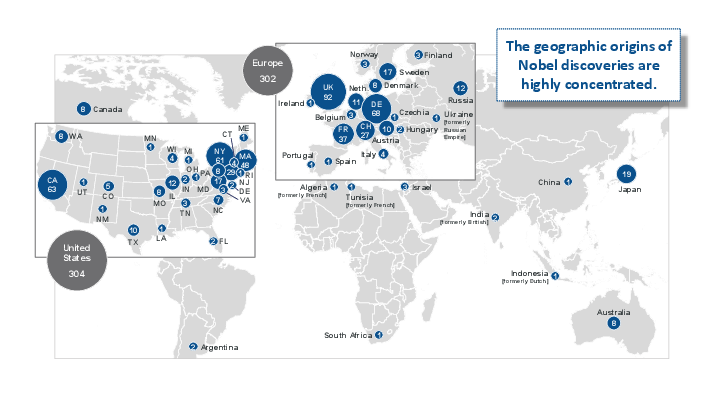
  • The geographic and institutional location of Nobel discoveries and the cross-border migration of eventual Nobel Prize recipients
  • Building, managing, and rebalancing global R&D and innovation networks
  • The three phases of organizational performance in emerging market operations
  • Managerial pitfalls of reverse innovation and how to overcome them
  • Leading innovation in life sciences
  • Seven steps in successful business incubation: how to build successful start-up companies
  • Measuring organizational maturity for open innovation
  • How to conduct post-project reviews in R&D and innovation
  • Technology upskilling of Chinese OEMs and ODMs: How to break into customer markets, and how to defend your home turf

Five Recent Managerial Publications

  1. Prud’homme, D., von Zedtwitz, M. (2025). The New Rules of Doing Business with China. Sloan Management Review 66, 4, 17-19. [link]
  2. Sehested, C., von Zedtwitz, M. (2025). Internationalisation – From Dream to Success. Djoef Forlag: Copenhagen.
  3. Prud’homme, D., von Zedtwitz, M. (2018). The Changing Face of Innovation in China. Sloan Management Review 59, 3, 24-32. [link]
  4. Hadengue, M., de Marcellis-Warin., N., von Zedtwitz, M., Warin, T. (2017). Avoiding the Pitfalls of Reverse Innovation. Research-Technology Management 60, 3, 40-47. (Finalist for the Maurice-Holland Award 2017) [link]
  5. Haour, G., von Zedtwitz, M. (2016). Created in China – How China is becoming a global innovator. London: Bloomsbury. 185 pages. [link]

Five Recent Academic Publications

  1. Knudsen, M.P., Schultz, C., Salomo, S., von Zedtwitz, M., Björk, J. (2026). The Role of Creativity and Innovation Management Research in Times of Changing Security and Defence Realities. Creativity and Innovation Management 35, 1, 84-90.
  2. von Zedtwitz, M., Gutmann, T., Engelmann, P. (2025). The Nobel “Pride” Phenomenon: An analysis of Nobel Prize discoveries and their recognition.  Research Policy 54, 1, #105150. [link]
  3. Dachs, B., Amoroso, S., Castellani, D., Papanastassiou, M., von Zedtwitz, M. (2024). The Internationalisation of R&D: Past, Present, and Future. International Business Review 33, 1, #102191. [link]
  4. Jang., S., von Zedtwitz, M. (2023). Opening up early or late? The effect of open innovation before and after product launch on new product performance. Industrial Marketing Management 112, 113-127. [link]
  5. Knudsen, M.P., von Zedtwitz, M., Griffin, A., Barczak, G. (2023). Best practices in new product development and innovation: Results from PDMA’s 2021 global survey. Journal of Product Innovation Management 40, 3, 257-275. [link]

Five “Classics”

  1. von Zedtwitz, M., Corsi, S., Soberg, P., Frega, R. (2015). A Typology of Reverse Innovation. Journal of Product Innovation Management, 32, 1, 12-28. (Winner of the 2016 Thomas P. Hustad prize for best paper in JPIM.) [link]
  2. Keupp, M., Friesike, S., von Zedtwitz, M. (2012). How Do Foreign Firms Patent in Emerging Economies with Weak Appropriability Regimes? Archetypes and Motives. Research Policy, 41, 8, 1422-1439. [link]
  3. Boutellier, R., Gassmann, O., von Zedtwitz, M. (2008). Managing Global Innovation - Uncovering the Secrets of Future Competitiveness. 3rd fully revised edition. Springer: Heidelberg. 807 pages. [link]
  4. von Zedtwitz, M., Gassmann, O. (2002). Market versus Technology Drive in R&D Internationalization: Four different patterns of managing research and development. Research Policy, 31, 4, 569-588. [link]
  5. Gassmann, O., von Zedtwitz, M. (1999). New Concepts and Trends in International R&D Organization. Research Policy, 28, 231-250. [link]


For a full list of publications, follow this link.

Contact

Max von Zedtwitz

Prof. Dr.

Managing Director & Professor

SGI-HSG
110 Amoy Street #03-01

069930 Singapore
north